
21-04-2026 13:36
Gernot FriebesHi,I am out of ideas for this one. I collected Sal
21-04-2026 13:19
Gernot FriebesHi,this Lophodermium on Typha has ascospores measu
21-04-2026 13:05
Gernot FriebesHi,this hyphomycete feels familiar but I was not a
20-04-2026 22:00
 Malcolm Greaves
These pale yellow, hairy ascos were growing on cul
19-04-2026 21:23
Steve ClementsBonjour, I found this anamorphic fungus on old pl
19-04-2026 20:46
Steve Clements1 mm diameter approx spherical conidiophores on pl
12-04-2026 17:56
 Hardware Tony
Found on dead stems in February earlier this year
17-04-2026 19:16
 Enrique Rubio
Hi to everybodyI would appreciate any assistance r
14-04-2026 05:32
Ethan CrensonHi all, A few weeks back a friend pointed out som
17-04-2026 15:14
 Bruno Coué
Bonjour.Récoltes du 16/04/2026, sur feuilles mort
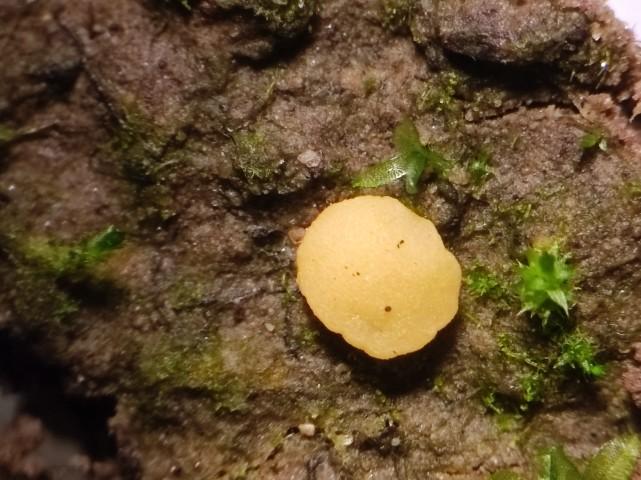
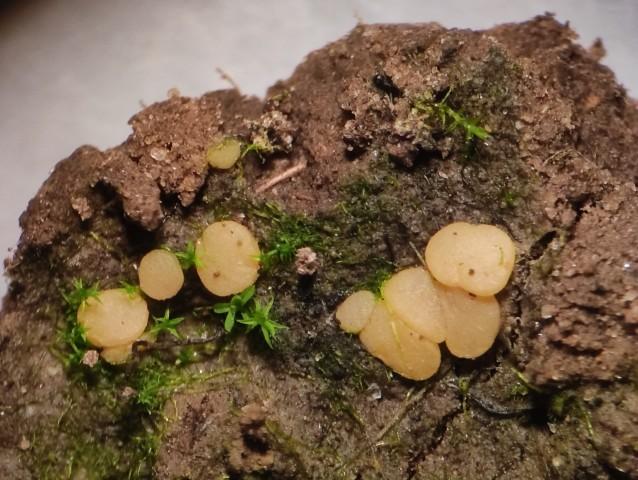
Cf. Byssonectria deformis ?
Collection 1, 10/12/2025
Seven specimen
Garden, Burgweg 19, Veurne Belgium
On bare ground
Macroscopie
? Apothecia: pale yellow to cream collared, disc-shaped, with smooth margin, not discolouring when touched/damaged, without subiculum, 2-4 mm Ø
Microscopie
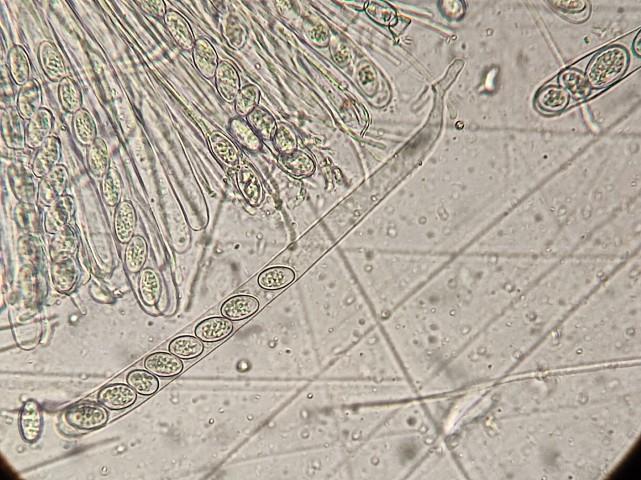
? Asci: cylindrical, operculate, J-, 171,5-196 x 9,8-13(-13,3) µm
? Sporen: hyaline, ellipsoid, lead, multi-guttulate, 14-16,6(-18) x 7,5-10,5 µm, Me = 15,48 x 8,58 µm, N = 10, Q = 1,80
? Parafysen: hyaline, cylindrical/filiform, 1,8-2,2 µm Ø, narrow clavate at the apex up to 4 µm Ø, with straight to curved apex
Collection 2, 17/12/2025
Twenty specimen
? Sporen: hyaline, ellipsoid, smooth, multi-guttulate, 14-17,5(-18,2) x 7,5-10,5 µm, Me = 16,15 x 9,14 µm, N = 12, Q = 1,76
? Parafyses: hyaline, cylindrical/filiform, 1,5-2 µm Ø, narrow clavate at the apex up to 3,5 µm Ø, with straight to curved apex
Any help for determination will be appreciated.
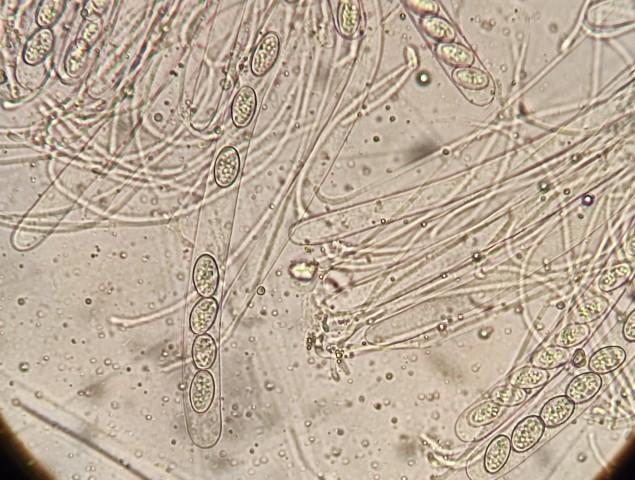
Boubovia ovalispora?
Thanks for your proposal and maybe/probably you are right but on "https://svampe.databasen.org/observations/10208492" the spores of B. ovalispora are ellipsoid, smooth, multiguttulate and measure 12,6-13,2 x 7,6-8,4 µm, which is shorter than 14-16,6(-18) x 7,5-10,5 µm in my found. That makes me a bit doubtful.
I would be grateful to recieve a key of the genus Boubovia.
pol.debaenst@msn.com
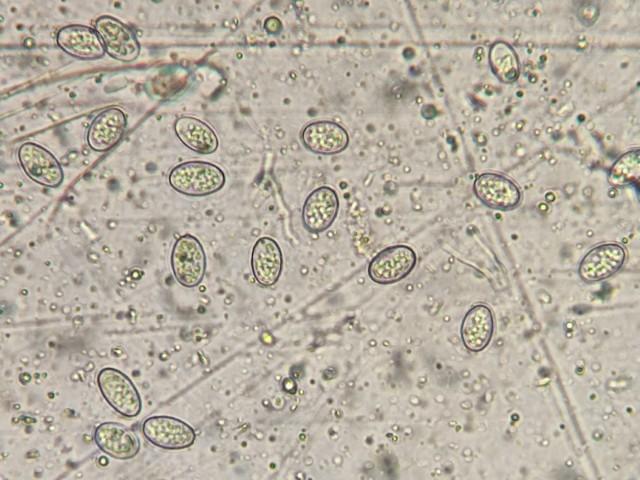
https://www.centrodeestudiosmicologicosasturianos.org/?p=48180

I remember that you lately posted Pictures of Pseudopithyella minuscula.
In our area (Center west of France) it is often collected with Pesudoboubobia benkertii. Some features of your collection would match but for the substrate . P. benkertii lies on woodchips or dead leaves of Cupressus macrocarpa.
Amitiés. Michel
Thank you very much for the identification. In my garden it was also found nearby Pseudopithyella minuscula.
Kind regards and happy new year.
Pol