
12-06-2026 14:50
 François Freléchoux
Bonjour, Voici la brève description d'une Mollis
10-06-2026 21:16
François Freléchoux
Bonsoir,Le dernier du jour, en attendant votre avi
11-06-2026 19:01
 William Slosse
Hello all,In an attempt to make a culture of a sus
11-06-2026 19:03
 Nicolas VAN VOOREN
Chers membres d'Ascofrance,Le site sera placé en

09-06-2026 18:32
Camille MertensSur morceau de roseau immergé 0,5 - 0,7 mm de dia
10-06-2026 12:54
Steve ClementsBonjour encore, Pouvez-vous m'aider, s'il vous pl
10-06-2026 21:07
François Freléchoux
Toutes les tiges de gentianes jaunes de l'an passÃ
10-06-2026 13:41
François Freléchoux
Bonjour à nouveau, Voici une trouvaille d'hier.
Ciboria à 4 spores
Nicolas VAN VOOREN,
22-05-2009 15:15
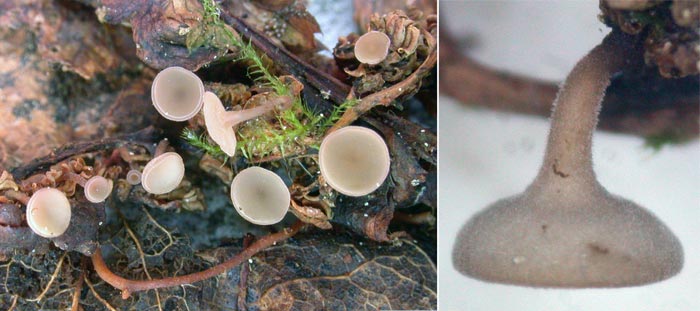
Récolté hier ce Ciboria sur châtons mâles d'Alnus viridis, en Savoie, alt. 1700 m.Apothécies de couleur beige pâle, Ø 0.7-2.2 mm, à surface externe très finement furfuracée.
Asques 70-84 x 6-7 µm, avec crochet, contenant 4 spores, pars sporifera 32-36 µm ; anneau apical IKI + (bb). Paraphyses Ø 2.5-4 µm. Spores 9-10.5 (11.5) x 4.5-5 µm.
D'après la clé de Zotto, ça collerait avec Ciboria acerina. Est-ce que vous avez une expérience de cette espèce ?
 7868.pdf
Hans-Otto Baral,
22-05-2009 17:46

Re:Ciboria à 4 spores
Hi Nicholas
as you see from my drawings on DVD the spores are binucleate in acerina. If you could verify that (visible in water with somewhat closed aperture or phase contrast), I would also say this is C. acerina.
There are also nor remnatnst of aborted spores in the asci.
Zotto
as you see from my drawings on DVD the spores are binucleate in acerina. If you could verify that (visible in water with somewhat closed aperture or phase contrast), I would also say this is C. acerina.
There are also nor remnatnst of aborted spores in the asci.
Zotto
Nicolas VAN VOOREN,
22-05-2009 18:57
Re:Ciboria à 4 spores
I confirm: spores binucleate.