
17-04-2026 19:16
 Enrique Rubio
Hi to everybodyI would appreciate any assistance r
14-04-2026 05:32
Ethan CrensonHi all, A few weeks back a friend pointed out som
17-04-2026 15:14
 Bruno Coué
Bonjour.Récoltes du 16/04/2026, sur feuilles mort
12-04-2026 15:52
Gernot FriebesHi,I'm looking for help with this anamorph collect
14-04-2026 21:52
Gernot FriebesHi,found on dead leaves of Carex elata. Conidia: 4
16-04-2026 22:09
Buckwheat PeteHello, I'd like to ask about this older specimen:
15-04-2026 19:33
Fátima Durán ManzanequeHi!! I need help, I found this Ascomycete but I d
14-04-2026 20:31
Gernot FriebesHi,can this be Psilachnum lateritioalbum on Phragm
12-04-2026 17:56
 Hardware Tony
Found on dead stems in February earlier this year
12-04-2026 12:22
 William Slosse
In a dune grassland in Oostduinkerke (Belgium), on
On Pseudotsuga
Enrique Rubio,
14-05-2022 21:03
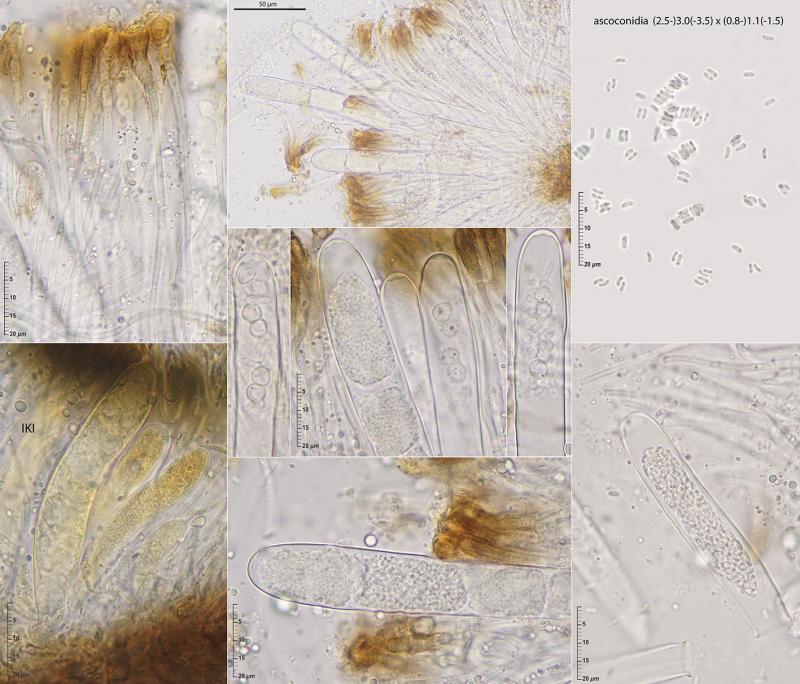
These sessile or subsessile apothecia, more or less turbinate, allways isolated, never in groups, 0.2-0.7 mm in diameter and blackish-brown in colour, erumpent through the bark of branches fallen to the ground in a plantation of Pseudotsuga menziesii at 1300 m of altitude in northern Spain .The apothecia have no ionomidotic reaction in KOH and the asci form very scanty primary ascosspores, difficult to see, but probably broadly ellipsoidal or subspherical, and finally the asci are filled with a multitude of small, subcylindrical to nearly allantoid, hyaline ascoconidia.
From the appearance of the primary spore it could perhaps be Tympanis tsugae Groves, which may now belong to Claussenomyces or Vexillomyces.
What do you think?



Hans-Otto Baral,
14-05-2022 21:21

Re : On Pseudotsuga
Hi Enrique
not sure what Tympanis tsugae is but surely this is a Tympanis, not a Vexillomyces. The globose non-septate spores which form a short germ tube inside the living asci are diagnostic. Also the red-brown excipulum does not fit a Vexillomyces.
Ouellette & Pirozynsky used the germination pattern as species marker, but Tympanis is a difficult genus, probably not really settled.
Zotto
Enrique Rubio,
14-05-2022 21:26
Re : On Pseudotsuga
Thank you, Zotto
When studying this paper and although I do not see the germination of the primary spore at all well, I turned to this species. But, as you, I'm not sure.
When studying this paper and although I do not see the germination of the primary spore at all well, I turned to this species. But, as you, I'm not sure.
Enrique Rubio,
14-05-2022 21:37
Re : On Pseudotsuga
By the way, where is your folder on Tympanidaceae?