Accès membres

Mot de passe perdu? S'inscrire

11-05-2026 12:32

Bernard CLESSE Bernard CLESSE

Pourriez-vous m'aider à identifier cette héloti

13-05-2026 15:26

François Freléchoux François Freléchoux

Bonjour,Voici une récolte faite il y a quelques j

12-05-2026 15:41

Nicolas VAN VOOREN Nicolas VAN VOOREN

Dear Ascolovers, especially interested in Pezizale

13-05-2026 12:05

Thierry Blondelle Thierry Blondelle

Bonjour à tous,J'aimerais avoir confirmation de c

10-05-2026 23:17

Andreas Gminder Andreas Gminder

Hello,today we found in a moist steep decidous for

28-04-2026 20:07

Lothar Krieglsteiner Lothar Krieglsteiner

... on twig in the air at standing Ceratonia siliq

27-04-2026 20:52

Lothar Krieglsteiner Lothar Krieglsteiner

Found on hanging tiwg of Olea europaea in dried-ou

11-05-2026 20:22

Lothar Krieglsteiner Lothar Krieglsteiner

on attached twig of standing Ficus caricaquite uns

11-05-2026 13:22

Sylvie Le Goff

BonjourPuis avoir votre avis sur cet ascome, je vo

29-04-2026 10:44

Lothar Krieglsteiner Lothar Krieglsteiner

growing at moist, drying-out soil at the side of a

« < 1 2 3 4 5 > »
Disco on Malus wood
Stefan Jakobsson, 05-05-2022 23:21
On the surface of a decorticated branch of Malus recently cut off from a standing tree there were some up to 0,4 mm long fruiting bodies of a more or less elliptic fungus for which I have no good ideas left. Young frbs are covered with a dark brown layer which later seems to break up and form a dark margin around the yellowish brown disc.

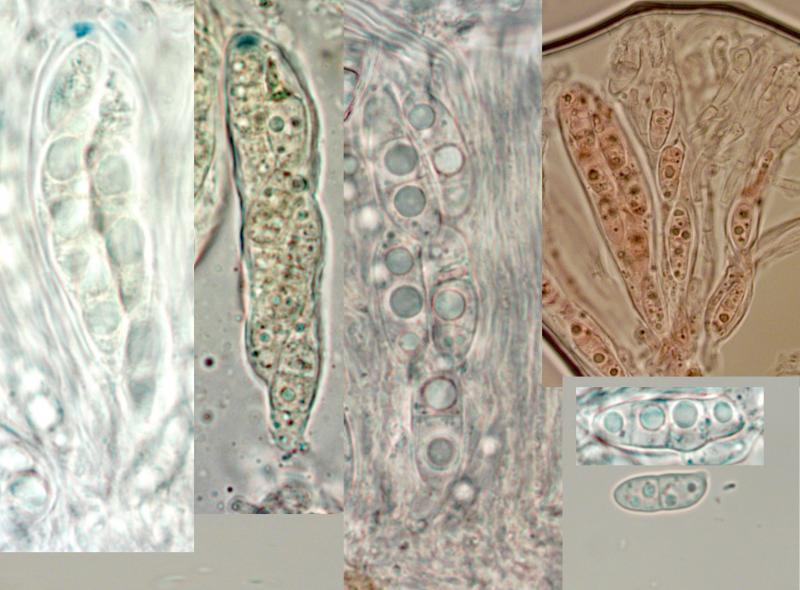
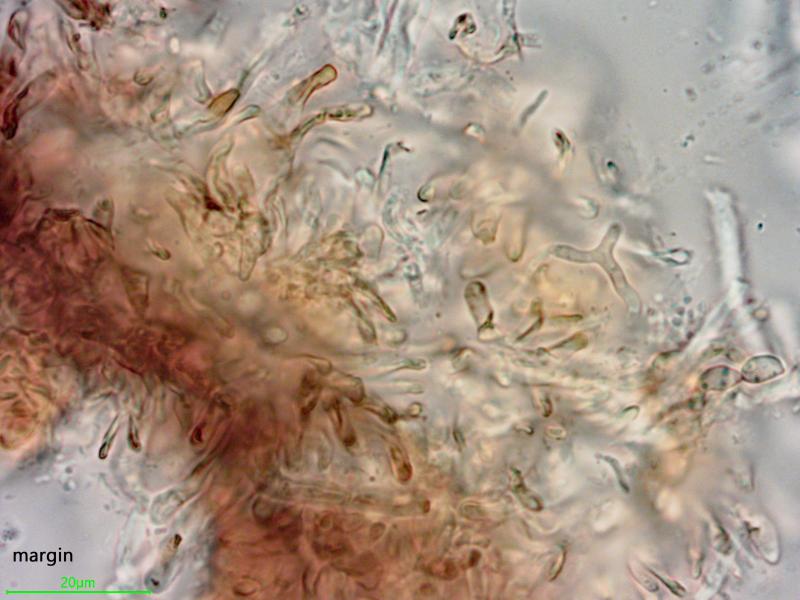
The spores are one to three times septate and at times germinating alredy in the ascus, 16.9-21.4 × 6.5-7.6 µm, with one large guttule in each cell. The asci are 50-76 × 12-16 µm, apex blue with and without pretreatment. The parafyses are agglutinated, best observed in ammoniacal CR, branched.


Any ideas what this could be? Southern Finland.
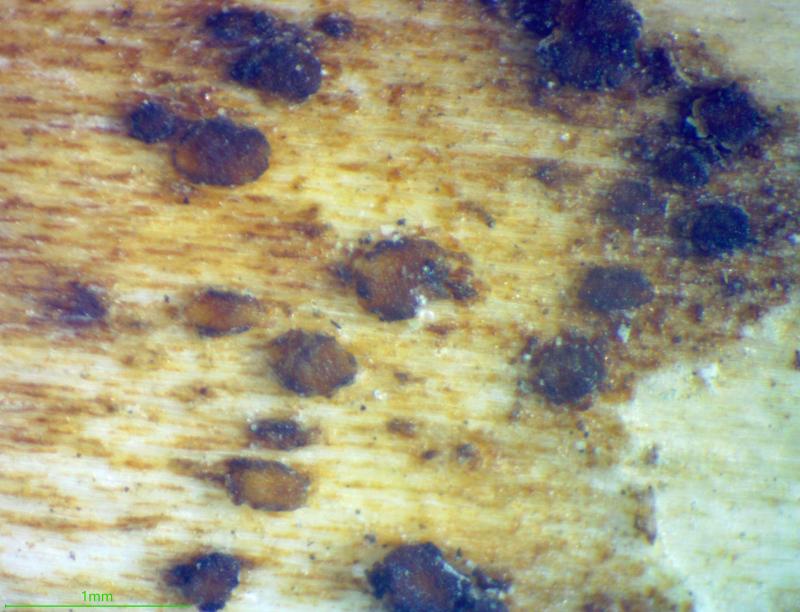
  • message #72649
  • message #72649
  • message #72649
Hans-Otto Baral, 06-05-2022 09:56
Hans-Otto Baral
Re : Disco on Malus wood
This looks much like a relative of Durella atrocyanea, for which i tentatively use Xylogramma (see my folder "Durella group"). But with its amyloid apical rings it is a very unusual species in Xylogramma. The only I have in my subfolder (from Asturias) has longer and narrower spores with less oil, and also has VBs in the paraphyses. Lots of un- or little known species exist in these drough-tolerant discos!
Stefan Jakobsson, 06-05-2022 21:43
Re : Disco on Malus wood
Thank you! Atrocyanea and the Asturian one are undoubtedly close.

I note the my photos went into the Asturian folder - by mistake I presume.
Hans-Otto Baral, 06-05-2022 22:04
Hans-Otto Baral
Re : Disco on Malus wood
Well noticed :-)

Now corrected