
14-08-2016 23:15
 Alex Akulov
Dear friendsCan you help me to find the descriptio

05-06-2026 11:02
Thomas Læssøehttps://svampe.databasen.org/observations/10596691
04-06-2026 11:36
Gernot FriebesHi,found on Vaccinium myrtillus.Asci: IKI –, 8-s
05-06-2026 12:10
 François Freléchoux
Capitotricha sp. sur Lonicea caerulea Caractères
19-05-2026 10:27
Patrice TANCHAUDBonjour, récolte récente sur terre retournée i
04-06-2026 18:39
Gernot FriebesHi,I collected this species in two different locat
22-05-2026 13:29
Gernot FriebesHi,I am curious to hear your opinion on this mater
Arachnopeziza aurata ?
Roland Labbé,
25-02-2009 00:42
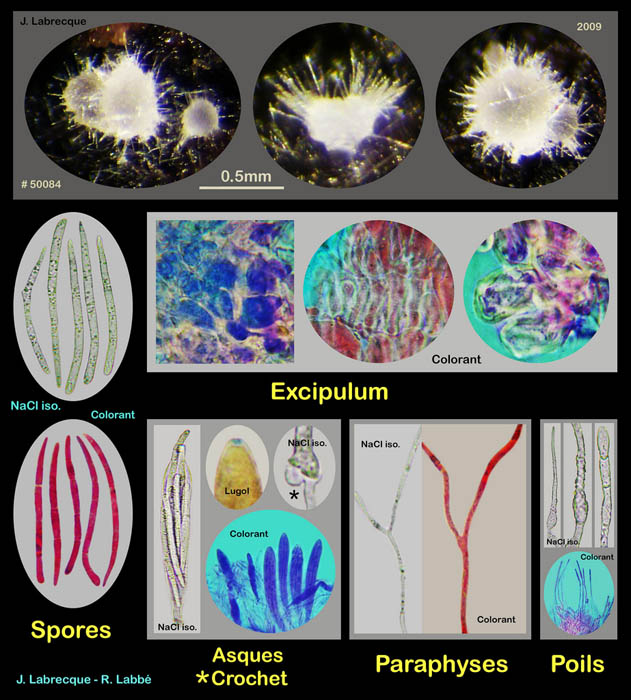
Voici une planche d'un disco que je crosi être Arachnopeziza aurata.
Il est possible que ce soit aussi A. delicatula.
Qu'en pensez-vous ? Merci.
Détails :
Date de récolte: 2009 / 02 / 16
Culture intérieure sur bûche en décomposition d'érable à sucre
Sporée non disponible
Ascome 0,2-0,7 mm de diam.
Spores cylindriques, arrondies à une extrémité et effilées à l'autre, à 5-7 septa, lisses, contenant de petites guttules, 10-20% environ du volume total, hyalines en NaCl iso., 45-68 x 2,5-3 µm, 59,2 x 2,8 µm (10 spores), Q = 21,14, possiblement incomplètement matures
Asques à 8 spores unisériées, avec un crochet à la base, à appareil apical amyloïde, 80-100 x 10-12 µm
Paraphyses cylindriques, parfois fourchues vers la base, septées, contenant environ 10-20% de guttules, hyalines, 1-1,5 µm de diam.
Poils fusoïdes, à paroi plutôt épaisse, incrustés, formés de cellules ellipsoïdes caténulées à la base (?), 150-250 x 4-5 µm
Excipulum en textura globulosa- angularis, formé de cellules à paroi épaisse
Richard Korf,
25-02-2009 06:34
Re:Arachnopeziza aurata ?
I think there is no doubt that this is A. aurata rather than A.delicatula.
Dick Korf
Dick Korf
Roland Labbé,
26-02-2009 16:27
Re:Arachnopeziza aurata ?
Thank you Dick.
What's about var. alba of this species ?
Roland
What's about var. alba of this species ?
Roland
Richard Korf,
26-02-2009 21:48
Re:Arachnopeziza aurata ?
I am currently in California, and cannot consult my notes. I'm not even sure I ever examined Grelet's type. In my experience there is a great deal of variation in pigmentation of the apothecia, "aurata" being more the exception as a color description than the rule. Certainly many collections show no or little coloration at all, and would qualify as "alba" when described. I'd surely want to examine Grele's description and the type(now in PC I believe) before deciding on what he described being what you have.
Dick
Dick
Roland Labbé,
26-02-2009 23:07
Re:Arachnopeziza aurata ?
Thank you Dick.
Roland
Roland