
12-06-2026 14:50
 François Freléchoux
Bonjour, Voici la brève description d'une Mollis
10-06-2026 21:16
François Freléchoux
Bonsoir,Le dernier du jour, en attendant votre avi
11-06-2026 19:01
 William Slosse
Hello all,In an attempt to make a culture of a sus
11-06-2026 19:03
 Nicolas VAN VOOREN
Chers membres d'Ascofrance,Le site sera placé en

09-06-2026 18:32
Camille MertensSur morceau de roseau immergé 0,5 - 0,7 mm de dia
10-06-2026 12:54
Steve ClementsBonjour encore, Pouvez-vous m'aider, s'il vous pl
10-06-2026 21:07
François Freléchoux
Toutes les tiges de gentianes jaunes de l'an passÃ
10-06-2026 13:41
François Freléchoux
Bonjour à nouveau, Voici une trouvaille d'hier.
 Bonsoir le forum,
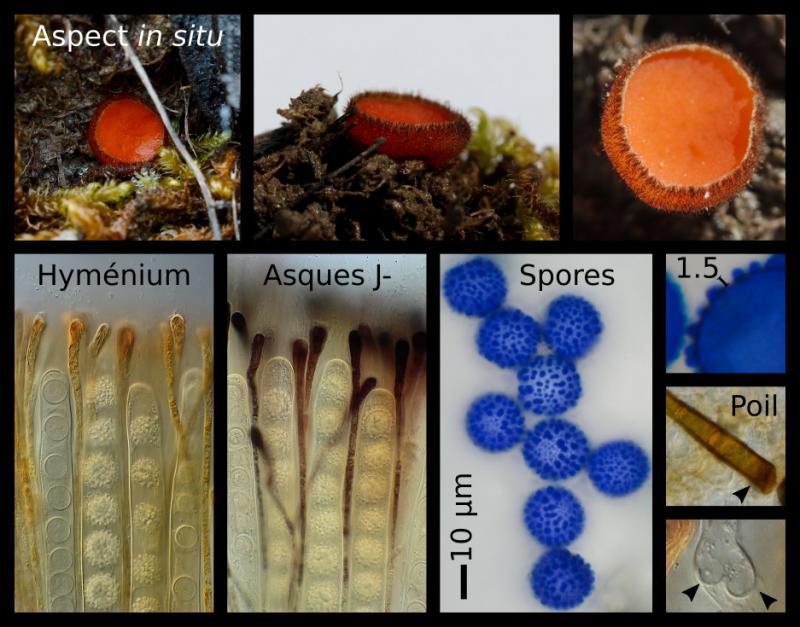
J'ai récolté dernièrement des Scutellinia à spores rondes que je pense être S. minor ou S. barlae. Les spores subglobuleuses et l'ornementation quelque peu hétérogène me font pencher pour S. minor. Qu'en pensez-vous ?
L'aspect général est typique du genre Scutellinia. Brièvement, apothécie < 1 cm, d'un bel orange uniforme, à marge un peu plus claire. Surface externe couverte de poils courts.
Spores subglobuleuses (Q = 1.1), (15) 17 +/- 0.87 (19) x (14) 15 +/- 1.1 (18) µm [(min) moyenne +/- écart-type (max), N = 14, mesures effectuées dans le bleu coton lactique, ornementation exclue], à verrues arrondies grossièrement homogènes (quelques-unes plus grosses) de (1.2) 1.5 +/- 0.1 (1.6) µm. Asques octosporés, inertes dans l'iode. Paraphyses cylindriques, cloisonnées, légèrement renflées au sommet, remplies d'un pigment orange qui se colore en violet dans le réactif de Melzer. Boucles présentes. Poils à paroi épaisse, jusqu'à 300 µm, à base simple ou bifurquée (jamais multiple).
Lieu de récolte : Baisse de la Plate, 2600 m, Alpes-Maritimes (France), en terrain schisteux. Zone humide, au milieu des mousses.
Cordialement,
Edouard

Thanks for the link. It helps a lot! I summarize as follows:
- S. barlae has globose spores, while those of S. minor are subglobose.
- The boreoalpine distribution of S. minor is compatible with my collection.
- One discrepancy though: my collection does not have many bifurcate hairs.
I will consider getting an ITS sequence for this collection.
Best wishes,
Edouard

regarding the supposed boreoalpine distribution of S. minor - I'm aware that both Schumacher and Matocec listed it as such. However, both Sphaerospora minor and its synonym Sc. subglobispora were described from rather warm areas of the Czech Republic and certainly not higher then some 500-600 m a.s.l. I have even collected it in 220 m a.s.l., ash-poplar-oak forest near Olomouc. Also the collections known in neighbour Slovakia are mostly from colline and submontane level. In these two countries at least it doesn't seem to be restricted to high altitudes, unlike e.g. S. pilatii or S. mirabilis.
Might be interesting to compare sequences of colline vs. alpine collections. But I don't know which genes are useful in this genus.
Viktorie