
27-04-2026 20:52
 Lothar Krieglsteiner
Found on hanging tiwg of Olea europaea in dried-ou
28-04-2026 22:51
 Bernard CLESSE
Bonsoir à toutes et tous,Pourriez-vous m'aider à
29-04-2026 08:01
Lothar Krieglsteiner
... on twig attached to small tree of Citrus auran
29-04-2026 10:44
Lothar Krieglsteiner
growing at moist, drying-out soil at the side of a
28-04-2026 20:33
Vitus SchäfftleinHello, I found Trochila ilicina on Ilex aquifoliu

28-04-2026 21:50
 Pablo Sandoval
Hola a todos,Espero se encuentren bien. Hace mucho
27-04-2026 18:05
Lothar Krieglsteiner
... still attached at standing tree. The green con
28-04-2026 20:07
Lothar Krieglsteiner
... on twig in the air at standing Ceratonia siliq
27-04-2026 18:48
Tony MoverleyCollected 23rd April 2026, Norfolk, EnglandSwarms
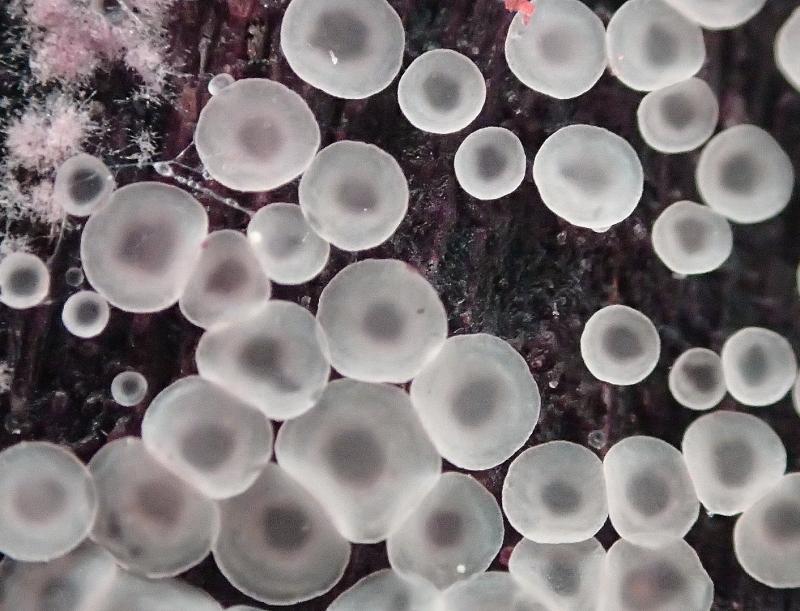
Something Orbilia-like growing on a piece of hardwood, probably Salix, on a wet lake shore, southern Finland not far from Karsten's hunting grounds. The diameter of the apo is up to 1 mm, very light brownish, soon drying to greyish, subsessile. Asci 20-25 x 3, clavate, IKI-. Paraphyses capitate, capitulum 3 µ, at its narrowest 1,5 µ, with something on the sides of the capitulum which I interpret to be remnants of an epithecium, often with a few septa further down. Spores cylindric, very difficult to catpture on a photo, something like 1 x 4 µ, mostly they seem so have a spore body in both ends and sometimes also something in the middle.
Could this be Orbilia epipora?
Stefan
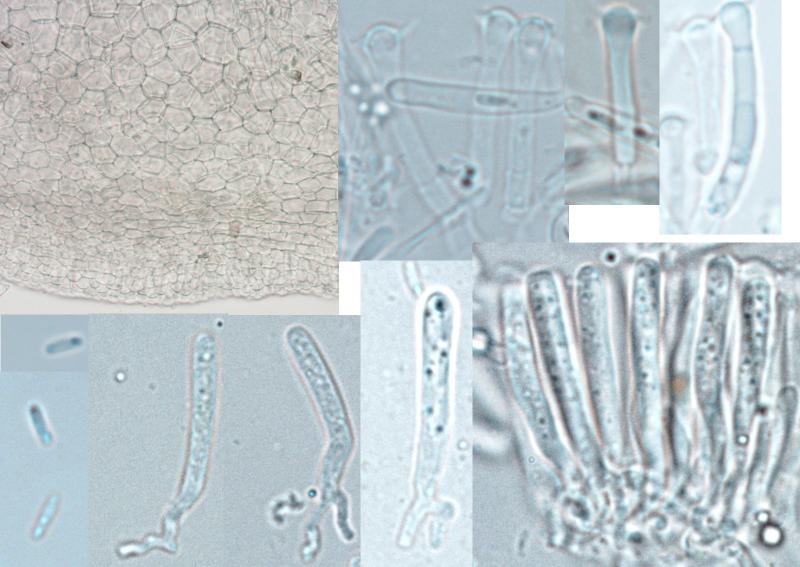

The paraphyses are covered by a thin exudate which is pushed up by the growing head. The word epithecium is often used for it, but I don't find it useful.
Typical is the gregarious growth of whitish apos in vast number.
Would you mind sending me the coordinates and collection date?
Did you check the wood anatomy to exclude e.g. Fraxinus or Fagus which are easy to recognize?
Zotto
Can I speak of a log or branch, or is it a fragment hereof?