
30-05-2026 21:12
Philippe PELLICIERSur branche de mélèze (Larix) près de la neige,
31-05-2026 10:35
Hulda Caroline HolteHello,I collected this species growing on a rather
25-05-2026 16:35
 Bernard CLESSE
Bonjour à toutes et tous,J'ai trouvé récemment,
29-05-2026 15:35
daniel FERREBonjour à tous,Je voudrais votre aide pour cette
28-05-2026 16:15
James MitchellHello,Does anyone have the original publication of
28-05-2026 11:06
Thomas Læssøehttps://svampe.databasen.org/observations/10596750
23-05-2026 11:44
 Charles Grapinet
Hello, I am having trouble identifying this copro
25-05-2026 16:44
François BartholomeeusenHi forum members,During an excursion organised by
26-05-2026 21:25
Dirk GerstnerHello everyone, I'm completely stumped by this li
26-05-2026 22:44
Ethan CrensonHi all, I think I have Incrucipulum capitatum her
this beautiful species has appeared in culture from Ledum palustre leaf washings. I am not sure if it is a weed species of it is native to the community on this plant. Probably someone here could be interested in this species or may help me with approximate ID.
Perithecia about 0.5 mm in diameter, pear-shaped, attenuated upper part bent, with partly submerged base, brown, covered by abundant brownish mycelium.
Excipulum from angular cells, 3-5 layered in section; hyphae abundant in lower part, no seta or short hairs; asci cylindrical, about 200 mk long, 16-18 broad, with refractive ring; paraphysoid tissue abundant, from chains of inflated cells; spores ellipsoid, dark brown, spore wall with pits about 0.5 mk, 28 (24.5-31.7) x 14 (13-15), n=10.
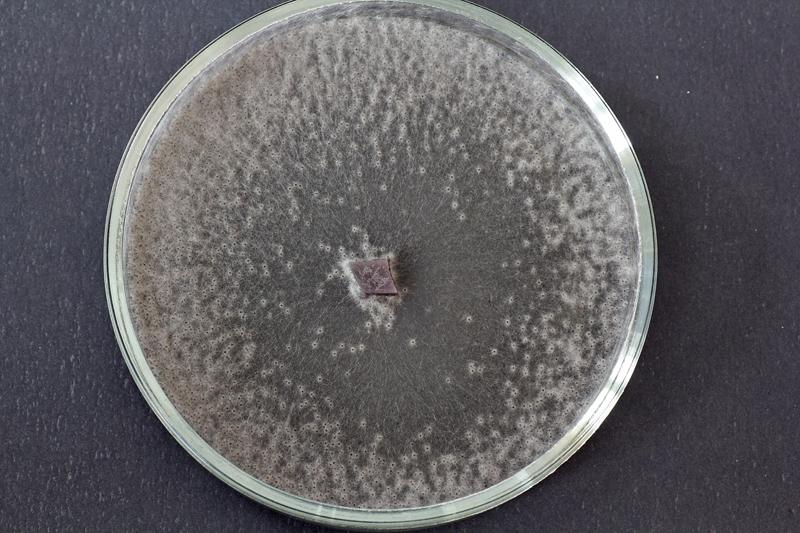


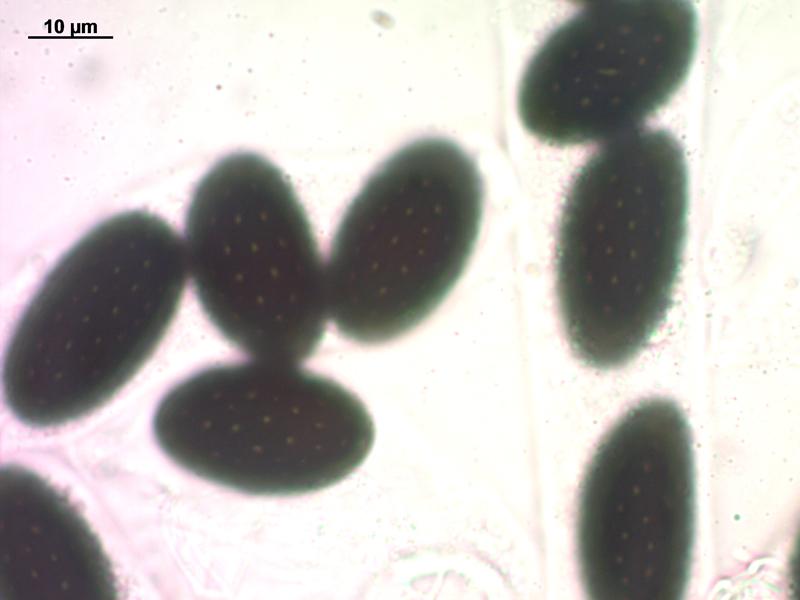

my description matches well with the description of this species i found in the paper (Cain, Roy F. "STUDIES OF COPROPHILOUS ASCOMYCETES: I. GELASINOSPORA." Canadian Journal of Research 28.5 (1950): 566-576).
According to this saurce, the species was collected from dung and plants (seeds) before and is common in N. Canada. I had not collected this species by direct observation on the subsrate, but contamination is not high in my room (usually quite clear cultures appear) so that i think it is possible to link this species to the substrate (Ledum leaf litter).
Nina.
Matsushima has a nice photo and description of this species in his beautiful 1975 book. His isolate was from soil in Alaska. I have seen it in moist chambers of dung with Sphagnum used to maintain the humidity. It probably came from the Sphagnum, not the dung. I am certain the Sphagnum would have had a few leaves of Ledum, L. groenlandicum in our case, mixed in. Cain always used Sphagnum in his moist chambers, so it's likely that was the source of his G. tetrasperma as well.
Dave

Nice find; certainly G.tetrasperma, spore size corresponds to that given by Roger Cailleux in his very interesting article on the Central African mycoflora coprophile ( Société Mycologique de France Tome LXXXVII Fascicule 3 1971 ).
Thank you to David for his remarks in relation to the presence of Sphagnum.
Michel.

Hello David can you give me the name of the book from Matsushima.
Joop

Chris
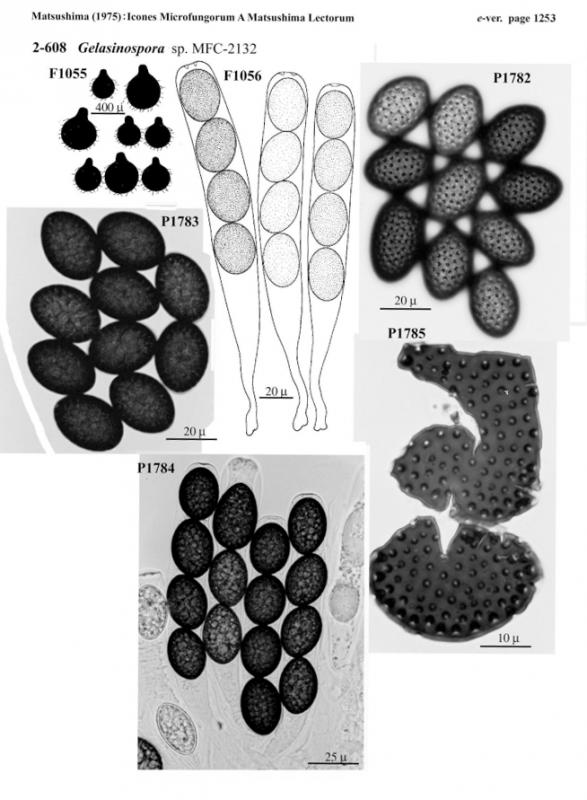
Sorry, my mistake. The photos were of his Gelasinospora sp. MFC-2132, not G. tetraspora. The book is:
Matsushima, T. 1975. Icones microfungorum a Matsushima lectorum. Published by the author, Kobe, Japan.
It appears from Chris's illustration there is an electronic version. That's fortunate since the original is hard to find.
Dave
http://www.amazon.com/gp/offer-listing/B007UJY4LK/ref=tmm_other_meta_binding_used_olp_sr?ie=UTF8&condition=used&sr=&qid=
Chris