
12-06-2026 14:50
 François Freléchoux
Bonjour, Voici la brève description d'une Mollis
10-06-2026 21:16
François Freléchoux
Bonsoir,Le dernier du jour, en attendant votre avi
11-06-2026 19:01
 William Slosse
Hello all,In an attempt to make a culture of a sus
11-06-2026 19:03
 Nicolas VAN VOOREN
Chers membres d'Ascofrance,Le site sera placé en

09-06-2026 18:32
Camille MertensSur morceau de roseau immergé 0,5 - 0,7 mm de dia
10-06-2026 12:54
Steve ClementsBonjour encore, Pouvez-vous m'aider, s'il vous pl
10-06-2026 21:07
François Freléchoux
Toutes les tiges de gentianes jaunes de l'an passÃ
10-06-2026 13:41
François Freléchoux
Bonjour à nouveau, Voici une trouvaille d'hier.
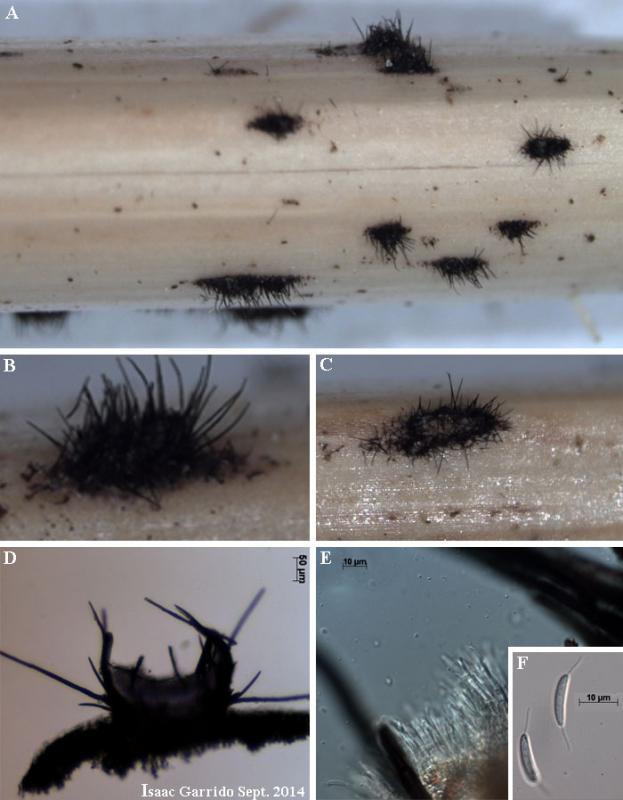
This is an unknown conidioma (may be an acervulum) with long hairs that grew on a dead grass in Castro Laboreiro (Portugal).
It was about 300 microns long and 220-250 microns in height. Black, long, septate hairs covering the whole pycnidium wall (300-560 microns long and 7-11 microns wide).
Conidia hyaline, 11.6-13.7 x 2.5-2.8 microns (without appendices), and up to 26.3 microns including the appendices.
I was thinking on a Colletotrichum species but I've not literature about it.
I will appreciate any suggestion.
Thanks!
Isaac
You can compare your sample with data from next references:
Duan, J.X., Wu, W.P. and Liu, X.Z. (2007) Dinemasporium (coelomycetes). Fungal Diversity
26: 205-218.
or
Webster, J. (1955). Graminicolous pyrenomycetes V. Conidial state of Leptosphaeria michotii,
L . microspica, Pleospora vagans and the perfect states of Dinemasporium graminum.
Transitions of the British Mycological Society 38: 347-365.
With best regards,
Martin.
Many thanks for your answer. I've checked the keys provided in the first paper and my samples match quite well with D. strigosum.
Thanks for the literature provided!
Best wishes,
Isaac