
11-05-2026 12:32
 Bernard CLESSE
Pourriez-vous m'aider à identifier cette héloti
13-05-2026 15:26
 François Freléchoux
Bonjour,Voici une récolte faite il y a quelques j
12-05-2026 15:41
 Nicolas VAN VOOREN
Dear Ascolovers, especially interested in Pezizale
13-05-2026 12:05
 Thierry Blondelle
Bonjour à tous,J'aimerais avoir confirmation de c
10-05-2026 23:17
 Andreas Gminder
Hello,today we found in a moist steep decidous for
28-04-2026 20:07
 Lothar Krieglsteiner
... on twig in the air at standing Ceratonia siliq
27-04-2026 20:52
Lothar Krieglsteiner
Found on hanging tiwg of Olea europaea in dried-ou
11-05-2026 20:22
Lothar Krieglsteiner
on attached twig of standing Ficus caricaquite uns
29-04-2026 10:44
Lothar Krieglsteiner
growing at moist, drying-out soil at the side of a
Bonjour !
Voici probablement un Pyrenopeziza.
Les espèces dilutella ou rubi nous semblent les plus probables.
Merci de votre aide et amitiés à vous tous !
Roland
Données :
Date de récolte : 20 / 06 / 2013
Substrat : vieille tige de framboisier
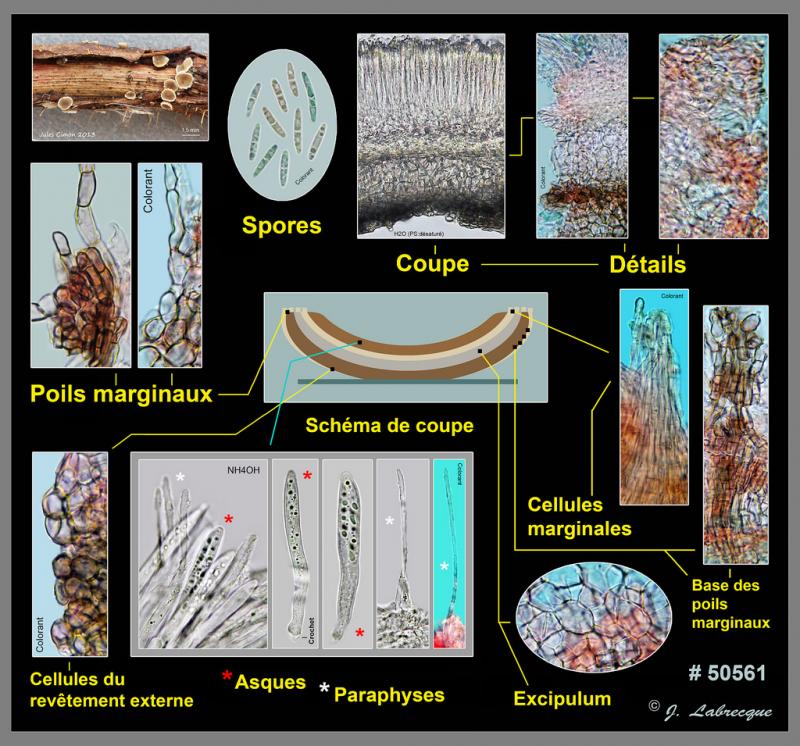
Asques inoperculés, à 8 spores bisériées, avec crochet à la base et appareil apical amyloïde, 48-82 x 4,8-7 um, 60,2 x 5,8 µm en moyenne
Paraphyses cylindriques, avec une ramification basale, légèrement élargies et enduites d'une substance gélatinisée à l'apex, septées, à contenu finement granuleux ± 80%, difficile à préciser sur spécimen déshydraté, 68-90 x 1,8-2,5 µm, dépassant les asques de 5-10 µm environ
Spores étroitement fusoïdes, lisses, avec un septum médian et 2 moyennes guttules, hyalines, 8,5-14 x 1,5-2,5 µm, 10,6 x 1,9 µm en moyenne, Q = 5,59
Excipulum ectal en textura globulosa, formé de cellules globuleuses à subglobuleuses, hyalines, 11-14 x 9-10 µm de diam.
Couche mince d'hyphes parallèles et hyalines probable d'une au-dessus de l'excipulum ectal
Revêtement externe formé de cellules arrondies, à paroi épaissie, brunâtres
Poils marginaux cylindriques, à paroi légèrement épaissie, septés, incrustés d'une substance gélatinisée, bruns à la base et devenant hyalins vers l'apex, 3-5 µm de diam.


your collection rather belongs to Pyrenopeziza dilutella. It is macroscopically recognisable due to its pale ocherbrown apothecia growing on Rubus stems.
regards,
björn
We have now one choice.
Amitiés ! Roland
Do you have a paper on Pyrenopeziza dilutella to send for me.
I want to know if Purenopezpza is the good genus for this species.
This is not the case for Index Fungorum.
Amitiés !
Roland

I also think it is P. dilutella (combination inexistent). But this name is more like a working name, though by Fries. Nobody knows exactly what Fries had in hand.
I have in my database only Ellis & Ellis as literature on "Mollisia" dilutella.
That it is no Mollisia you can only find out for sure when you bstudy living material. Look at Susana's photos of the two Mollisias from yesterday showing the contents (VBs) in the paraphyses. No chance with dead material.
In P. dilutella there are globose SCBs in the living paraphyses.
Have a look at my folder Pyrenopeziza on Rubus:
https://www.cubby.com/pl/Pyrenopeziza+on+Rubus/_ad1e512b1a73455883ec513cfa261630
Zotto