
02-05-2026 13:06
Pauline. PennaBonjour Please can someone help me with this id
02-05-2026 12:42
Alain BRISSARDBonjour à tousJeuidi 30 avril dernier on m'a remi
01-05-2026 22:45
 Thierry Blondelle
Bonjour à tous, Une récolte sur bouse séchée d
28-04-2026 20:07
 Lothar Krieglsteiner
... on twig in the air at standing Ceratonia siliq
14-04-2026 05:32
Ethan CrensonHi all, A few weeks back a friend pointed out som
28-04-2026 20:33
Vitus SchäfftleinHello, I found Trochila ilicina on Ilex aquifoliu

30-04-2026 10:28
Rot BojanHello, by appearance I would say that I am dealing
27-04-2026 18:48
Tony MoverleyCollected 23rd April 2026, Norfolk, EnglandSwarms
27-04-2026 20:52
Lothar Krieglsteiner
Found on hanging tiwg of Olea europaea in dried-ou
Mitrula paludosa measure spores
Miguel Ángel Ribes,
12-08-2013 11:07
 Good morning
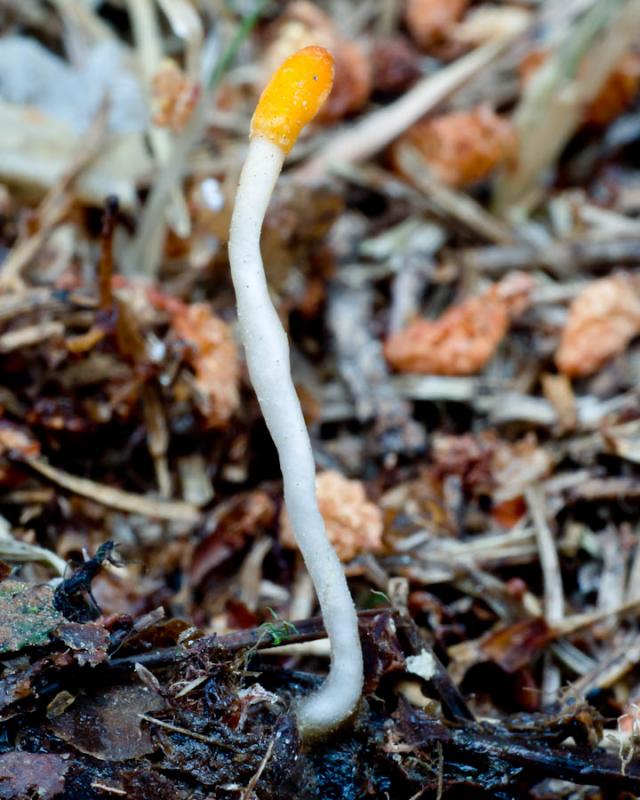
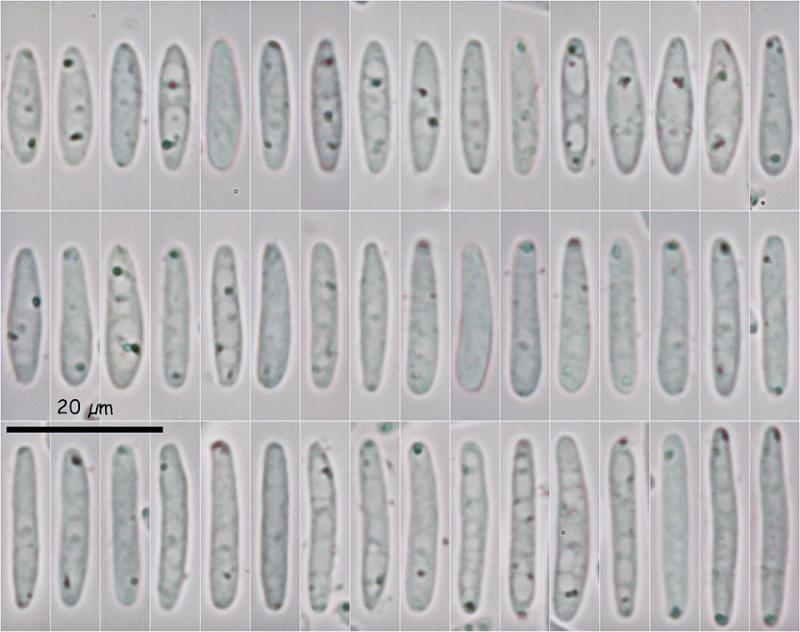
I have this strange single "Mitrula" with a very variable size and shape spores: navicular the smallest and cylindrical the bigest one. Measurements in water, 1000x, live:
(13.8) 16.1 - 22.3 (26.1) x (2.7) 3.4 - 4.9 (6.0) µm
Q = (2.6) 3.5 - 6.3 (7.6) ; N = 184
Me = 18.9 x 4.1 µm ; Qe = 4.7
Asci acuminate at apex, euamyloid and croziers +. Crystals presence. Without capitate caulocystidia.
I have never studied a Mitrula before now. I have see in the internet M. lunulatospora and M. elegans ¿?
Thank you.
Hans-Otto Baral,
12-08-2013 11:40

Re : Mitrula paludosa measure spores
Hi Miguel
this is actually rather variavle and wide. But from your scale I measure 14.5-26 x 2.8-4.5 µm, with the below row only 2.8-3.5 µm wide.
Especially the length is quite surprizing indeed. In the literature I find 10-15 or 12-17 µm, but Smith 1973 gives 10-20 x 2-3, or Imai 10-18 x 2-4 or Grund 1967 12.5-18.5 x 2.5-3.7.
Mitrula phalloides is thought to be a synonym, but Boudier found 19-23 x 3-4 (his measurements are usually quite correct concerning length).
Zotto
this is actually rather variavle and wide. But from your scale I measure 14.5-26 x 2.8-4.5 µm, with the below row only 2.8-3.5 µm wide.
Especially the length is quite surprizing indeed. In the literature I find 10-15 or 12-17 µm, but Smith 1973 gives 10-20 x 2-3, or Imai 10-18 x 2-4 or Grund 1967 12.5-18.5 x 2.5-3.7.
Mitrula phalloides is thought to be a synonym, but Boudier found 19-23 x 3-4 (his measurements are usually quite correct concerning length).
Zotto
Miguel Ángel Ribes,
12-08-2013 13:49
Re : Mitrula paludosa measure spores
Hi Zotto
In the picture there are only 48 spores, but really I measured 184:
(13.8) 16.1 - 22.3 (26.1) x (2.7) 3.4 - 4.9 (6.0) µm
Q = (2.6) 3.5 - 6.3 (7.6) ; N = 184
Me = 18.9 x 4.1 µm ; Qe = 4.7
I guess we will must check the place and study more collections with more specimens.
No possibility about Heyderia sp, isn't it?
Best wishes.
In the picture there are only 48 spores, but really I measured 184:
(13.8) 16.1 - 22.3 (26.1) x (2.7) 3.4 - 4.9 (6.0) µm
Q = (2.6) 3.5 - 6.3 (7.6) ; N = 184
Me = 18.9 x 4.1 µm ; Qe = 4.7
I guess we will must check the place and study more collections with more specimens.
No possibility about Heyderia sp, isn't it?
Best wishes.
Hans-Otto Baral,
12-08-2013 14:58
Re : Mitrula paludosa measure spores
Hi Miguel Angel
The colour (yellow/white) is impossible for Heyderia which has an ochraceous cup and a darker, brownish stipe. Also, the spores of Heyderia contain mre oil and more towards the middle, and the paraphyses contain distinct elongate VBs. Heyderia is not aquatic.
Do these broad spores also occur inside the living asci?
What is the substrate, Pinus needles?
Zotto
The colour (yellow/white) is impossible for Heyderia which has an ochraceous cup and a darker, brownish stipe. Also, the spores of Heyderia contain mre oil and more towards the middle, and the paraphyses contain distinct elongate VBs. Heyderia is not aquatic.
Do these broad spores also occur inside the living asci?
What is the substrate, Pinus needles?
Zotto
Miguel Ángel Ribes,
13-08-2013 10:24
Re : Mitrula paludosa measure spores
Thank you Zotto
Inside de asci, this are the measurements, I guess inmature spores because are shorter and narrower, but Qe is very similar (4.7 in free spores and 4.4 in asci spores):
(8.3) 10.9 - 18.0 (20.7) x (2.0) 2.9 - 3.7 (3.9) µm
Q = (2.9) 3.5 - 5.5 (6.7) ; N = 33
Me = 14.5 x 3.3 µm ; Qe = 4.4
The habitat is not the typical from Mitrula paludosa (inside the water). It was a betula-pinus forest, very near to a small stream, in a small slope with moss, very wet, attached to plant debris, but not directly on pine needles.
Best regard.
Inside de asci, this are the measurements, I guess inmature spores because are shorter and narrower, but Qe is very similar (4.7 in free spores and 4.4 in asci spores):
(8.3) 10.9 - 18.0 (20.7) x (2.0) 2.9 - 3.7 (3.9) µm
Q = (2.9) 3.5 - 5.5 (6.7) ; N = 33
Me = 14.5 x 3.3 µm ; Qe = 4.4
The habitat is not the typical from Mitrula paludosa (inside the water). It was a betula-pinus forest, very near to a small stream, in a small slope with moss, very wet, attached to plant debris, but not directly on pine needles.
Best regard.