
10-06-2026 13:41
 François Freléchoux
Bonjour à nouveau, Voici une trouvaille d'hier.
09-06-2026 18:32
Camille MertensSur morceau de roseau immergé 0,5 - 0,7 mm de dia
10-06-2026 11:53
Steve ClementsBonjour, This disco is abundant on dead stems of
10-06-2026 12:54
Steve ClementsBonjour encore, Pouvez-vous m'aider, s'il vous pl
10-06-2026 10:45
François Freléchoux
Bonjour à nouveau, Encore une détermination qui
08-06-2026 10:16
 Spooren Marco
I don`t have a clou about this fungus,it is not in
10-06-2026 09:24
François Freléchoux
Bonjour, J'imagine que cette détermination ne do
08-06-2026 17:00
François BartholomeeusenGood day everyone, On June 5 2026, I collected de
07-06-2026 15:10
 William Slosse
Hello everyone,On 05-06-26, I found following asco
Voici un mini disco qui a poussé sur une feuille morte de Physocarpe doré
Peut-être un Microscypha ?
Merci de nous aider encore.
Amitiés, Roland
Données :
Substrat : feuille morte
Spores étroitement ellipsoïdes, légèrement atténuées-obtuses à un bout, lisses, avec rares petites guttules difficiles à préciser, 6-8 x 1,5-2 µm, 6,9 x 1,9 µm en moyenne, Q = 3,63
Asques à 8 spores bisériées, avec crochet à la base et appareil apical amyloïde, à contenu dextrinoïde, 22-41 x 5-6 µm
Paraphyses cylindriques, parfois légèrement élargies ou atténuées-obtuses à l'apex, septées et fourchues à la base, à contenu très difficile à préciser (rares petites guttules vers la base ?), 22-45 x 1,5-2 um, ne dépassant pas les asques ou très peu
Medulla en textura celluleux ? Difficile à préciser, car dans une substance gélatineuse
Excipulum ectal en textura porrecta
Poils marginaux cylindriques, finement échinulés, multiseptés, à section apicale mesurant jusqu'à 45 x 4 um, bruns
Poils externes semblables, mais plus courts, bruns
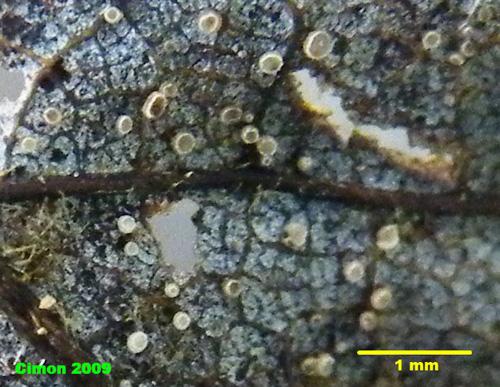
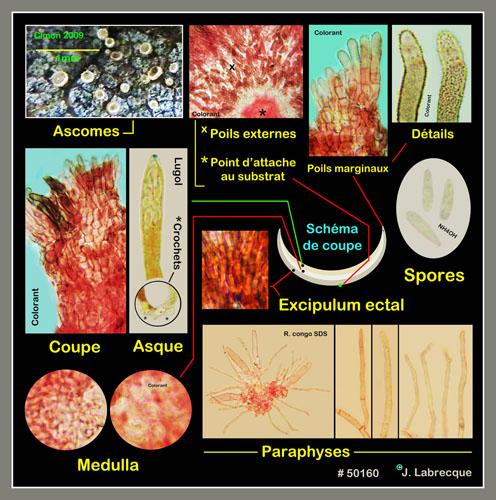

The ectal excipulum should be of a hyaline t. globulosa with brown external patches.
The species seems restricted to leaves of Salix. On Betula leaves occurs something very similar: Pyrenop. betulicola
Was this found recently or the last year?
Zotto
The leaves are : ''Physocarpe doré''
We will check again the ectal excipulum.
Roland
Here is new photo of what we think is ectal excipulum, but not stained.
Is-it enought clear ?
Roland
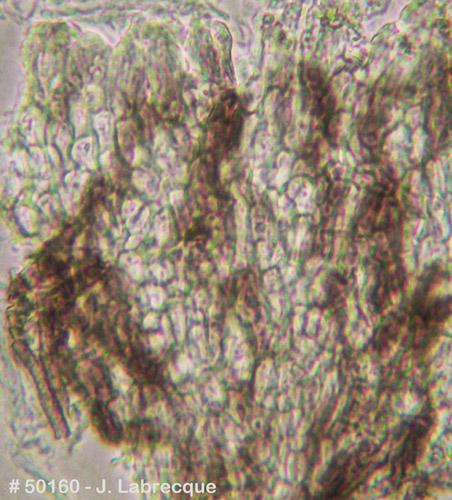
From the shape of the leaf you cannot say the host genus? Your remark The leaves are : ''Physocarpe doré''? I could not translate :-(
Zotto
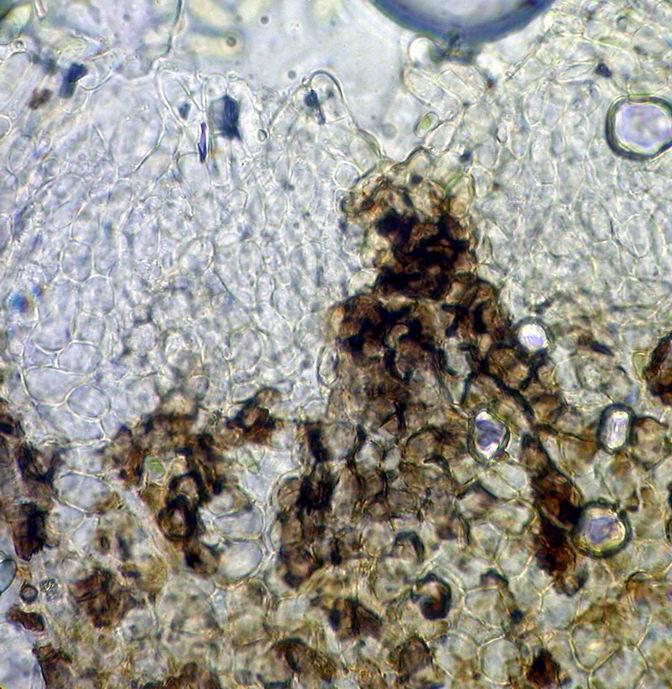
Then Microscypha or Pyrenopeziza fuckelii ?
Roland

"Physocarpe doré" = Physocarpus opulifolius
The type of Microscypha is M. grisella = M. arenula, and I do not believe that this species on ferns is mollisiaceous, mabye rather related to Urceolella.
The present fungus P. fuckelii s.l. fits quite well in Pyrenopeziza, in my opinion.
Zotto
That's what I want to know Hans !
And thank you for your help,
Roland
I must apologize, a friend (Ingo Wagner) drew my attention to the warty hairs of your fungus, and that it could rather be a Fuscolachnum instead of a Pyrenopeziza. Apparently F. misellum from Rubus leaves is not very different. Considering that Physocarpus is also a Rosaceae, we imagine that your fungus might be in fact F. misellum. ?
Zotto