
10-06-2026 13:41
 François Freléchoux
Bonjour à nouveau, Voici une trouvaille d'hier.
09-06-2026 18:32
Camille MertensSur morceau de roseau immergé 0,5 - 0,7 mm de dia
10-06-2026 11:53
Steve ClementsBonjour, This disco is abundant on dead stems of
10-06-2026 12:54
Steve ClementsBonjour encore, Pouvez-vous m'aider, s'il vous pl
10-06-2026 10:45
François Freléchoux
Bonjour à nouveau, Encore une détermination qui
08-06-2026 10:16
 Spooren Marco
I don`t have a clou about this fungus,it is not in
10-06-2026 09:24
François Freléchoux
Bonjour, J'imagine que cette détermination ne do
08-06-2026 17:00
François BartholomeeusenGood day everyone, On June 5 2026, I collected de
07-06-2026 15:10
 William Slosse
Hello everyone,On 05-06-26, I found following asco
Nectrialike on soil
Martin Bemmann,
30-10-2011 14:52
 Hello,
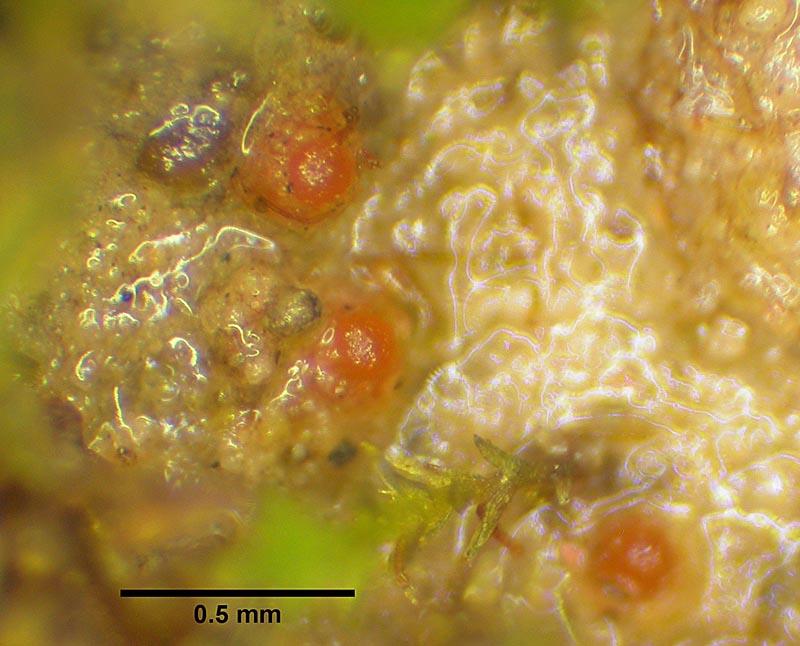
today I found on soil a nectriacious fungus growing between mosses and nostoc, close to Aleuria aurantia and Octospora sp..
Ascomata measure 0.25 mm in dm.
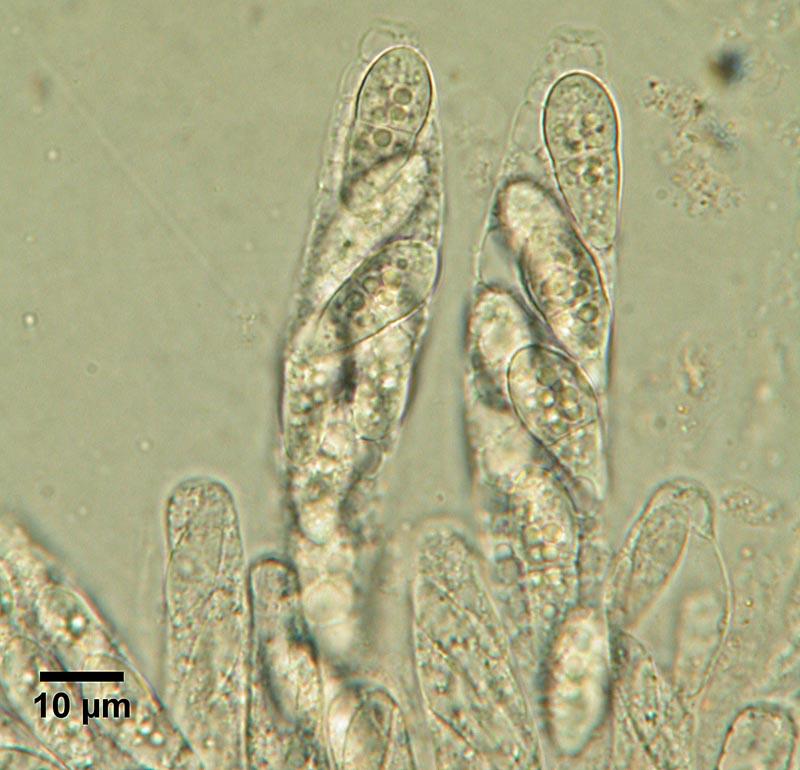
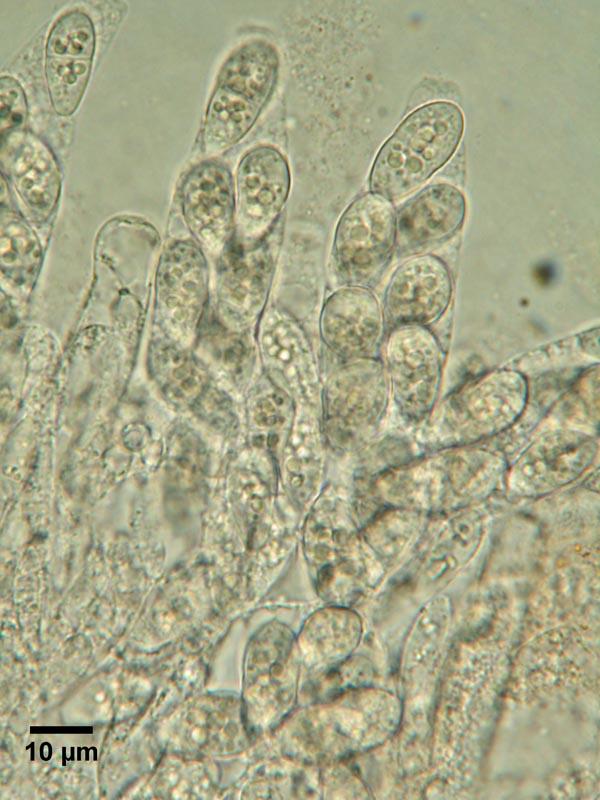
Spores are uniseptate with many oildrops and measure 19.5-22.4x8.5-9.7 µm.
Anyone an idea?
Best regards,
Martin
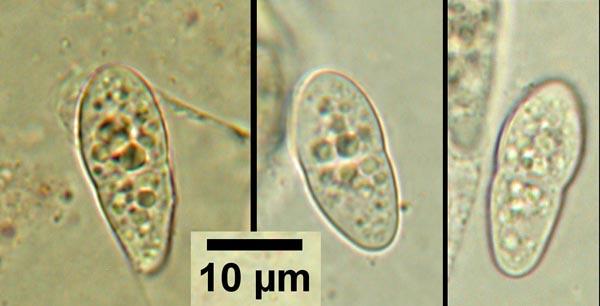
Hans-Otto Baral,
30-10-2011 17:26

Re : Nectrialike on soil
Hi Martin
I fear you need to test the peridium with KOH. But the spores are quite heteropolar, unlike Hypocreales
Zotto
I fear you need to test the peridium with KOH. But the spores are quite heteropolar, unlike Hypocreales
Zotto
Christian Lechat,
30-10-2011 18:08

Re : Nectrialike on soil
Hi Martin,
maybe it is the genus Pronectria.
Could you make a vertical section of the ascomatal wall?
Are there some paraphyses among the asci? I assume that the ascomatal wall does not change of color in KOH?
Regards,
Christian
maybe it is the genus Pronectria.
Could you make a vertical section of the ascomatal wall?
Are there some paraphyses among the asci? I assume that the ascomatal wall does not change of color in KOH?
Regards,
Christian
Martin Bemmann,
30-10-2011 22:07
Re : Nectrialike on soil
Hi Zotto and Christian,
I am short with KOH. I ordered fresh supply that will reach me next week... I wonder, however, if I will be able to make a section through these tiny sandburied ascomata. :-( It will be a crunchy experience I presume...
My hope was that the ecology would possibly give a hint.
@Zotto: you are right with the heteropolar spores, but to my impression they occur among hypocreales as well. I furthermore do not exclude that these spores are submature (very few "free ones") and possibly mute to muriforme ones...
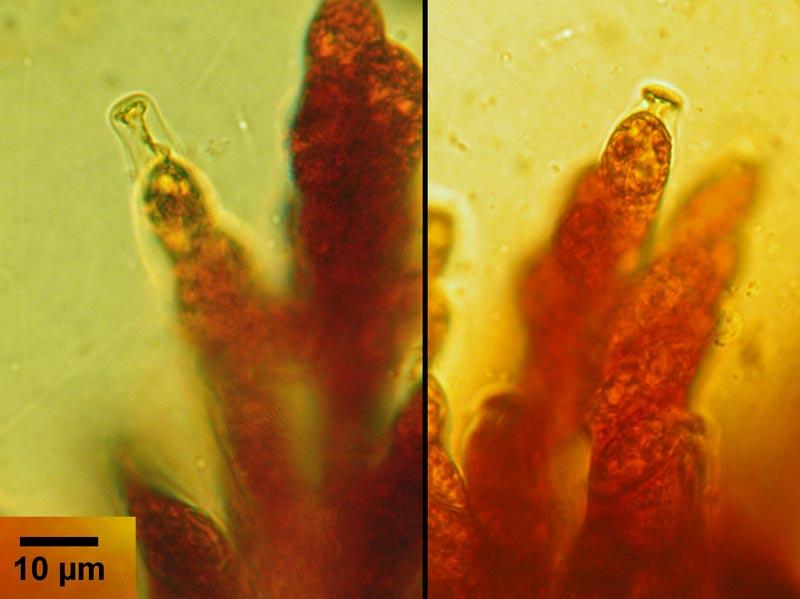
@Christian: I think I saw a single paraphysislike thing (I searched for those) that was filiform with a very slight apical thickening.
Best regards,
Martin
I am short with KOH. I ordered fresh supply that will reach me next week... I wonder, however, if I will be able to make a section through these tiny sandburied ascomata. :-( It will be a crunchy experience I presume...
My hope was that the ecology would possibly give a hint.
@Zotto: you are right with the heteropolar spores, but to my impression they occur among hypocreales as well. I furthermore do not exclude that these spores are submature (very few "free ones") and possibly mute to muriforme ones...
@Christian: I think I saw a single paraphysislike thing (I searched for those) that was filiform with a very slight apical thickening.
Best regards,
Martin
Christian Lechat,
31-10-2011 04:30
Re : Nectrialike on soil
Here is a PDF of Pronectria terrestris, Martin, take a look at it to see if it fits with your specimen.
Christian
Christian
 Pronectria-terrestris-0001.pdf
Martin Bemmann,
31-10-2011 18:16
Re : Nectrialike on soil
Hi Christian,
thank you very much for this paper! I contacted Paul Diederich and he is inclined to agree that this is Pronectria terrestris. His second collection featured spores of the size as in mine. I tried to collect some more specimen today but had no time yet to search with the dissecting microscope.
Best regards
Martin
thank you very much for this paper! I contacted Paul Diederich and he is inclined to agree that this is Pronectria terrestris. His second collection featured spores of the size as in mine. I tried to collect some more specimen today but had no time yet to search with the dissecting microscope.
Best regards
Martin