
02-11-2024 16:34
 B Shelbourne
• Host suggests Sawadaea bicornis or Phyllactini
31-10-2024 22:25
Karen PoulsenHello, On half weathered Betula leaf, I noticed t
31-10-2024 21:42
Karen PoulsenHello, On last year's pine needles on the ground
28-10-2024 17:51
B Shelbourne
• Macro and habitat suggest Hymenoscyphus s.l.,
28-10-2024 23:30
 Marc Detollenaere
Dear Forum,I found some small fruit bodies of abou
25-10-2024 02:15
B Shelbourne
• Very few macro characters and I initially thou
26-10-2024 16:19
Juuso ÄikäsYesterday I found some small white Helotiales grow
25-10-2024 22:17
Daniel GhyselinckHi everybody,Found in mountain area at about 1000m

Dear friends
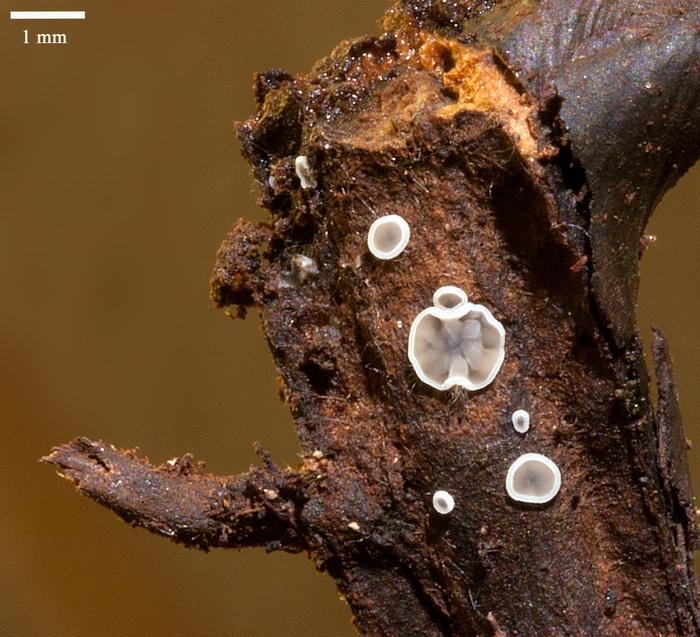
This Mollisia makes small greyish fruitbodys on rhizomes of Juncus balticus at 1800 m of altitude.
Asci up to 40 x 5, IKI b, with croziers, 8-spored. Ascomata KOH negative. The ascospores I think are narrower of those of Mollisia palustris.
Have you some idea?
Thanks
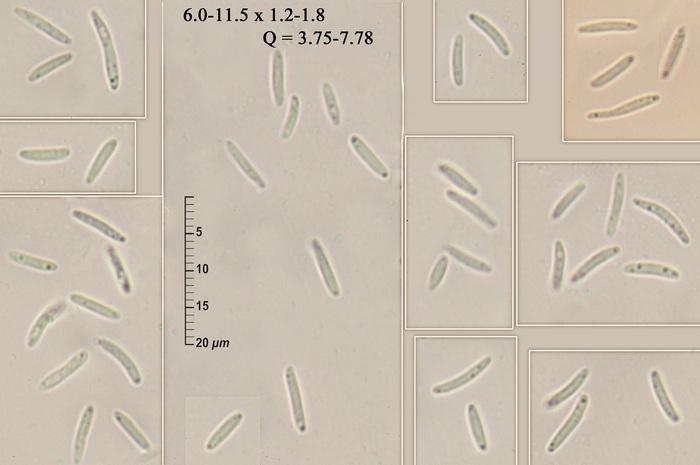


I wonder if this has some relation to Mollisia chionea? The ascospores would be of comparable thickness, but are at the shorter lengths of your collection. It has been reported on Juncus in the UK several times and is (I think) a possible tentative match.
http://biodiversitylibrary.org/page/8967530#page/172/mode/1up
http://biodiversitylibrary.org/page/8967530#page/162/mode/1up (figures 21-24)
Discorehmia eburnea is a synonym of Mollisia chionea (according to Index Fungorum), and is described with ascospores 7-8 x 1.5 um, which would be more in line with your collection.
But there's always the possibility that these two species could be misclassified in Mollisia - I haven't looked into the matter very far!
Either way, I think your species is probably a close relative of one of the Mollisia palustris look-alikes, but not conspecific.
Cheers,
Brian
Hi Brian
Perhaps is a possibility, although the whitish/translucent colour of the ascomata of M. chionea and the shorther ascospores are different.
I think so. This fungus is very close related with M. palustris but is not the same species.
Many thanks for help me